

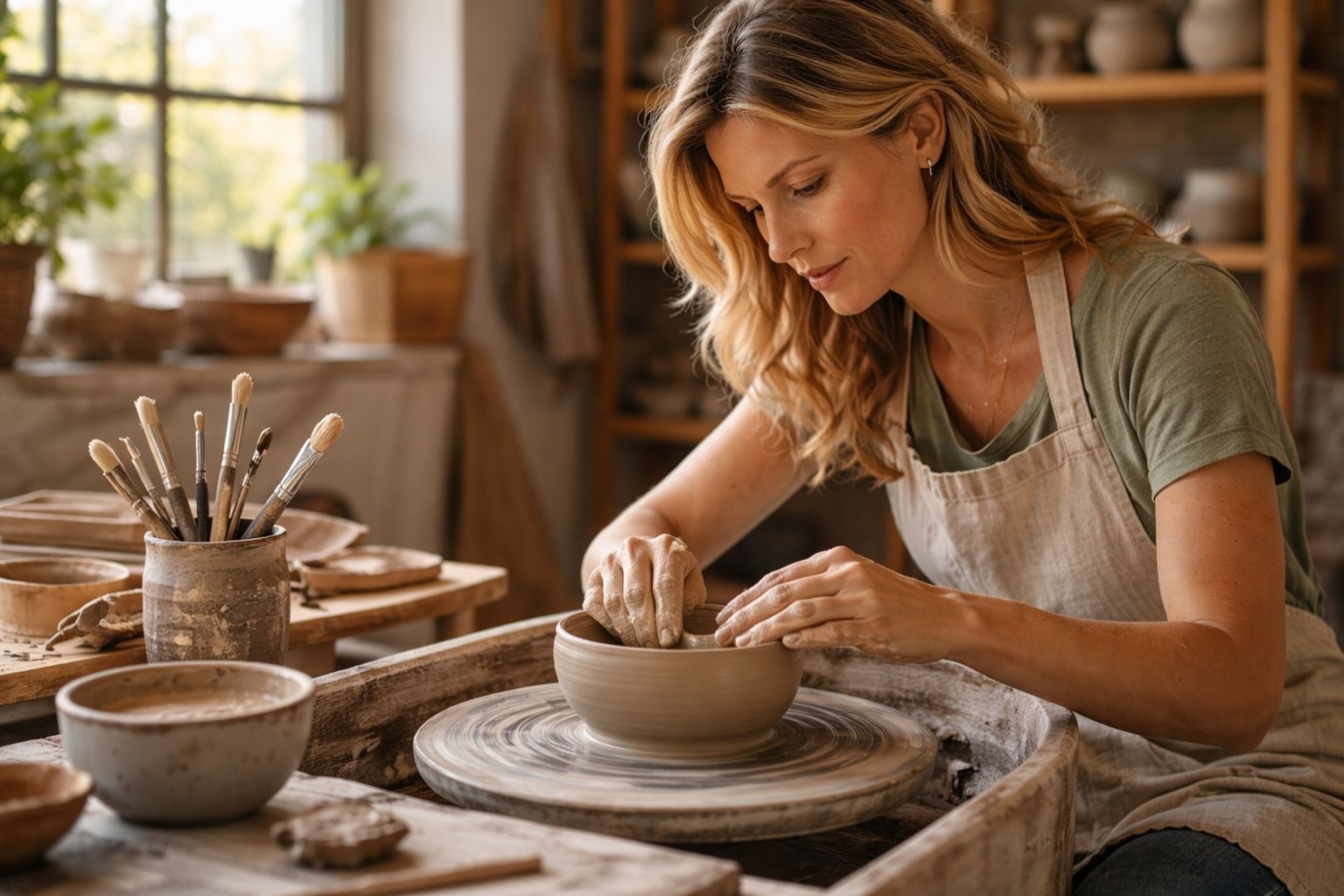
In an economy driven by speed, abstraction and digital output, working with the hands can feel anachronistic. Productivity is measured in clicks, words, files and metrics. Value is increasingly detached from physical effort. And yet, at the margins of this hyper-digital culture, making things with your hands is quietly returning. Not as nostalgia, but as necessity.
For many women in particular, manual creation has become a way to reconnect with agency, meaning and presence in a world that often feels disembodied.
The loss of physical feedback
Much of contemporary work produces no tangible trace. Emails disappear, documents update endlessly, tasks blur into one another. The absence of physical feedback makes effort harder to register and completion harder to feel.
Handmade work restores a direct cause-and-effect relationship. You touch material. You apply force. You see resistance. You observe change. The result exists independently of screens and platforms.
This feedback loop is not trivial. It grounds attention and anchors effort in reality.
Cognitive relief in a fragmented world
Modern life demands constant cognitive switching. Notifications, multitasking and information overload fragment attention. For many people, this creates a persistent sense of mental fatigue without visible accomplishment.
Manual activities—sewing, woodworking, ceramics, gardening, knitting, cooking—engage the brain differently. They require focus, but not constant decision-making. The hands take over part of the cognitive load, allowing the mind to slow down without disengaging.
This state is not passive. It is regulated attention. And it has measurable effects on stress reduction and emotional balance.
Skill without performance
One of the most important aspects of making things by hand is that skill develops without spectacle. There is no audience, no algorithm, no immediate validation. Progress is internal and cumulative.
For women accustomed to performing competence in professional and social spaces, this can be deeply liberating. Manual creation allows learning without judgment. Mistakes are material, not personal. Failure becomes part of the process rather than a threat to identity.
This creates a rare space where worth is not negotiated externally.
Reclaiming authorship and control
Making something with your hands establishes authorship in a direct way. You are responsible for choices, outcomes and imperfections. There is no interface mediating your input.
In a world where many systems feel opaque and unresponsive, this control matters. It restores a sense of efficacy. You act. Something changes.
For women whose labor is often abstract, relational or invisible, manual creation offers a form of visibility that does not depend on recognition. The object exists whether or not it is praised.
The gendered history of manual work
Historically, women’s manual skills have been undervalued. Textile work, domestic crafts and care-related making were categorized as hobbies or duties rather than expertise. Industrialization and professionalization further separated “serious” work from handwork associated with femininity.
The renewed interest in craft challenges this hierarchy. It reframes manual skill as knowledge, not nostalgia. It acknowledges the intelligence embedded in hands.
This shift is not about returning to traditional roles. It is about reclaiming undervalued forms of competence.
Material thinking in an abstract economy
Making things by hand trains a kind of thinking that is increasingly rare. Material thinking accounts for limits, resistance, time and consequence. You cannot rush drying clay or ignore the grain of wood. Materials demand negotiation.
This mode of thinking contrasts sharply with digital environments, where undo buttons and infinite replication obscure consequence. Manual work reintroduces constraint, and with it, responsibility.
In this sense, handwork is not a retreat from modernity. It is a corrective to its excesses.
Not a hobby, but a practice
The value of making things with your hands does not depend on monetization or mastery. It does not need to become a side hustle or content. Its importance lies precisely in being outside performance metrics.
When manual creation is allowed to remain a practice rather than a product, it sustains rather than drains. It offers continuity in a life defined by transitions.
This matters especially in moments of burnout, uncertainty or change, when abstract goals lose traction.
Presence as resistance
Making things with your hands demands presence. You cannot fully outsource attention. You must be there, physically and mentally. In a culture that rewards constant availability and distraction, this presence becomes quietly radical.
It asserts that time spent not optimizing, not producing measurable output, not performing is still valuable.
In that sense, handwork is not about productivity. It is about inhabiting time differently.
Why it still matters
Making things with your hands matters because it reconnects thought and action. Because it restores proportion between effort and outcome. Because it creates meaning without requiring justification.
In a world that increasingly lives in abstraction, the hand reminds us that understanding begins with touch, that learning involves friction, and that not everything important can be scaled.
The value of handwork is not in what it produces, but in what it returns: attention, agency and a sense of being grounded in the world.