

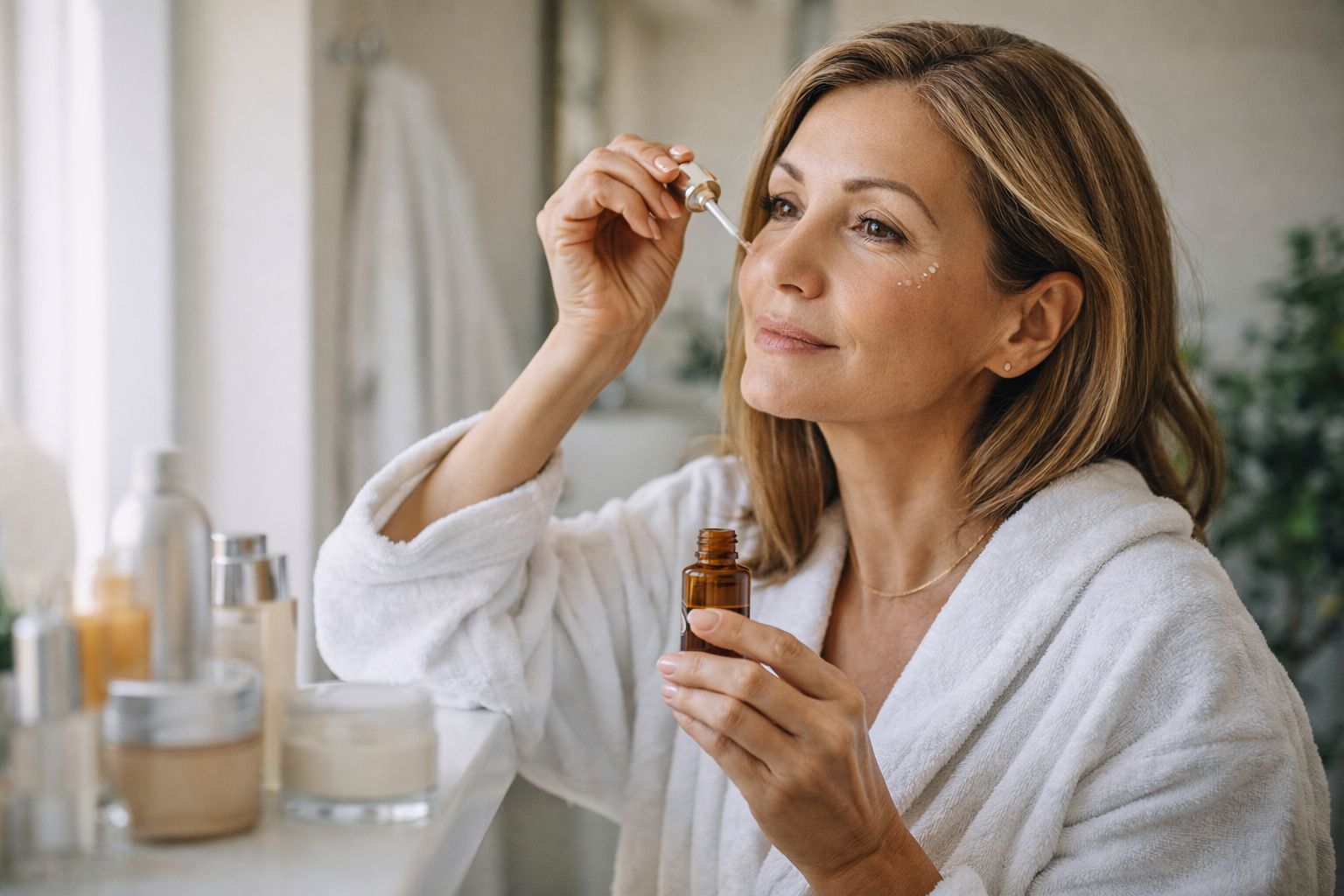
Turning 40 does not radically transform a face overnight, but it does change the relationship many women have with beauty. Routines become less about correction and more about care. Less about trends, more about understanding what the skin actually needs. The shift is subtle, progressive, and deeply personal. After 40, beauty stops being a performance and starts becoming a form of maintenance, awareness and, often, self-respect.
Skin changes, not rules
The most common misconception is that there is a single “after 40” routine. In reality, changes depend on genetics, lifestyle, hormonal balance and cumulative stress. What does tend to shift is skin behavior.
Cell turnover slows down. Collagen production decreases. Skin may feel drier, thinner or less reactive than before, while pigmentation and uneven texture become more visible. These are not flaws to fix, but signals to interpret.
As a result, routines often simplify. Aggressive exfoliation, constant product switching and over-layering lose appeal. Consistency starts to matter more than novelty.
Hydration becomes central
One of the most noticeable changes after 40 is how skin responds to hydration. Even women who previously had oily or combination skin often experience increased dryness, especially during seasonal changes or periods of hormonal fluctuation.
Moisturizers become richer, but not necessarily heavier. Ingredients like ceramides, glycerin, hyaluronic acid and squalane take precedence over harsh actives. The goal shifts from “controlling” the skin to supporting its barrier.
This is also the phase where facial oils, once avoided, are often reintroduced as complementary rather than primary products.
Active ingredients, used differently
Retinoids, acids and vitamin C do not disappear from routines after 40, but their role changes. Frequency matters more than intensity. Recovery becomes as important as stimulation.
Many women reduce exfoliation and focus on fewer, better-tolerated actives. The emphasis moves from visible short-term results to long-term skin health. Irritation is no longer considered an acceptable side effect.
This change reflects a broader cultural shift in beauty, where resilience is valued over instant transformation.
The face is no longer isolated
Another key evolution is the extension of skincare beyond the face. Neck, décolleté, hands and eye area receive more consistent attention. These zones are not treated as problem areas, but as natural extensions of facial care.
At the same time, makeup routines often become lighter. Coverage gives way to correction. Texture matters more than opacity. Products that enhance skin rather than mask it tend to replace full-coverage foundations and heavy powders.
Beauty after 40 often favors luminosity over perfection.
Hormones enter the conversation
Hormonal changes, even before menopause, influence skin elasticity, sensitivity and hydration. Many women only start connecting internal changes with external effects at this stage.
As a result, beauty routines become more integrated with lifestyle. Sleep, nutrition, stress management and physical activity are recognized as part of skincare, not separate from it. The bathroom mirror reflects choices made throughout the day.
This awareness also fuels a growing interest in dermatological advice over generic beauty trends.
A more personal definition of beauty
Perhaps the most significant change after 40 is psychological. Beauty routines stop being aspirational and start becoming personal. The focus shifts from looking younger to looking well.
There is less tolerance for routines that feel punishing or time-consuming. Pleasure, comfort and familiarity gain value. Products are chosen because they work, not because they promise transformation.
This does not mean giving up on beauty. It means redefining it. Beauty after 40 is less about becoming someone else and more about recognizing oneself.
In that sense, the real change is not on the skin, but in the gaze.