

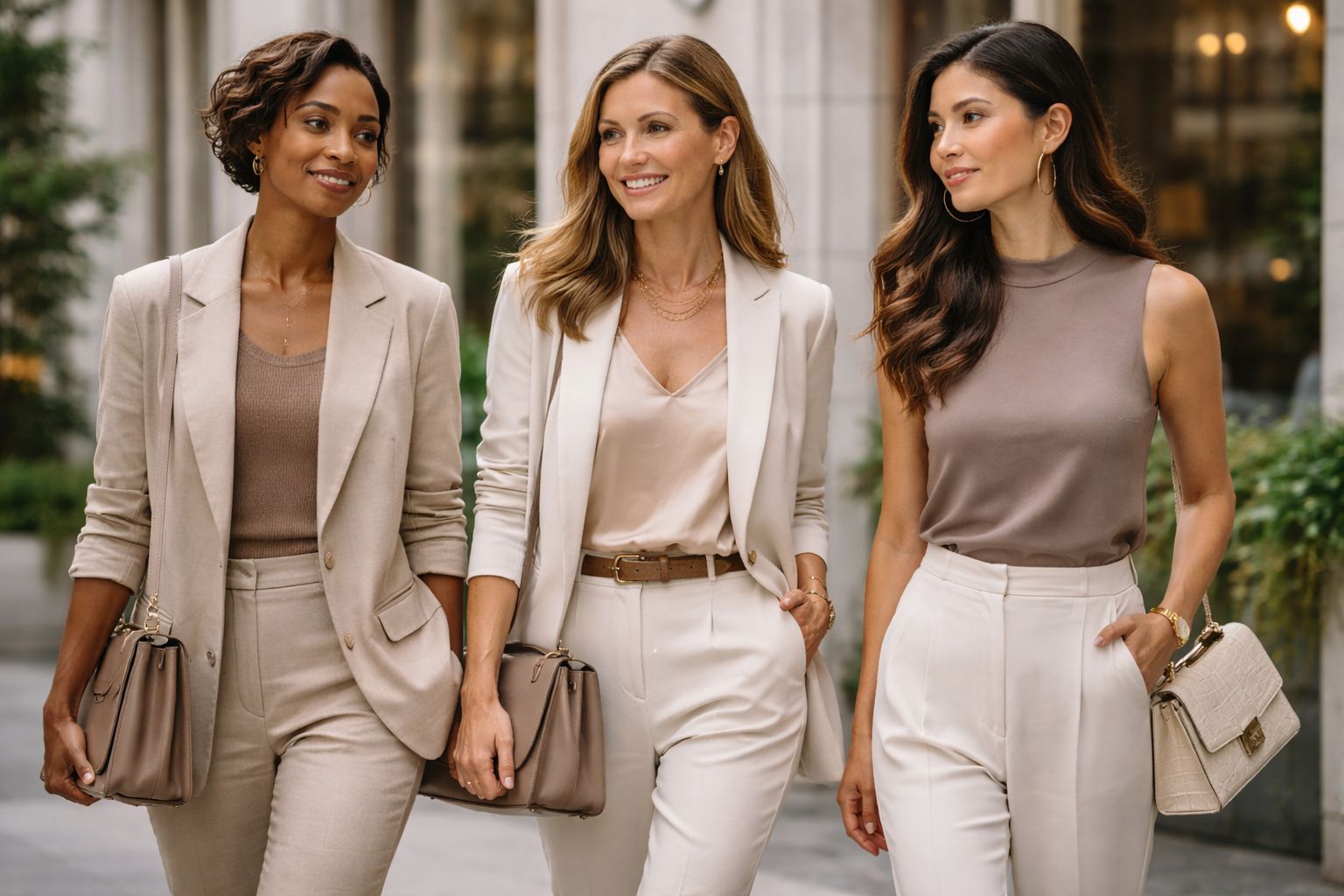
Quiet luxury is often described as an aesthetic. Neutral palettes, impeccable tailoring, discreet materials, logos reduced to whispers. But treating it as a mere trend misses the point. Quiet luxury is not only about how women dress. It is about how they position themselves in the world.
In recent years, this understated approach to fashion has emerged as a visual language of female power. Not the power that demands attention, but the one that assumes it. Not performance, but control.
From display to intention
For decades, fashion has been used as a tool of visibility. Especially for women, dressing up often meant being seen, noticed, validated. Loud logos, statement pieces and overt signals of status played into a system where recognition was external.
Quiet luxury marks a shift from display to intention. Clothing is no longer chosen to communicate wealth or trend awareness, but to support presence, authority and autonomy. The message is not “look at me”, but “I know who I am”.
This change reflects a broader cultural movement. As women gain economic independence and decision-making power, the need to prove status through fashion diminishes. Power becomes internalized, and style follows.
The aesthetics of control
The silhouettes associated with quiet luxury are not accidental. Tailored blazers, fluid trousers, structured coats and high-quality knitwear create a sense of composure and control. These garments are designed to last, to move easily through different contexts, and to avoid visual noise.
This is not minimalism as deprivation. It is minimalism as strategy. By reducing distraction, attention shifts to the person rather than the outfit. The wearer is not overshadowed by her clothes. She is supported by them.
In professional and social environments, this translates into a form of authority that feels calm rather than confrontational. Quiet luxury does not compete. It occupies space.
A reaction to excess
The rise of quiet luxury is also a reaction to years of overexposure. Social media, fast fashion and influencer culture have accelerated consumption and amplified visual saturation. Trends cycle faster, logos grow louder, novelty becomes exhausting.
For many women, quiet luxury represents relief. Fewer choices, better quality, less pressure to constantly update one’s image. It aligns with a desire for stability and coherence in a fragmented cultural landscape.
This does not mean rejecting fashion. It means slowing it down. Investing in fewer pieces that carry meaning, function and longevity.
Power without permission
One of the most interesting aspects of quiet luxury is its refusal to seek approval. It does not ask to be liked. It does not rely on external validation. This resonates strongly with women who have moved beyond the need to perform femininity according to prescribed standards.
Quiet luxury does not deny femininity. It reframes it. Softness coexists with strength. Elegance is not equated with compliance. Comfort is not seen as a lack of ambition.
In this sense, quiet luxury becomes a form of resistance. Against overconsumption. Against constant self-presentation. Against the idea that women must always explain or justify their choices.
Not a uniform, but a mindset
It is important to note that quiet luxury is not a uniform. It is not defined by specific brands or price points. At its core, it is a mindset. One that values coherence over spectacle, intention over impulse.
This mindset can be translated at different economic levels. Tailoring, fabric quality and fit matter more than labels. Personal style becomes more relevant than trend adherence.
The real shift is not what women wear, but why they wear it.
A cultural recalibration
Quiet luxury and female power intersect at a moment of cultural recalibration. As women renegotiate their roles in work, relationships and public life, fashion adapts. It becomes less about aspiration and more about alignment.
This does not mean the end of boldness or playfulness in fashion. It means that boldness is no longer mandatory. Loudness is optional. Visibility is a choice, not an obligation.
Quiet luxury is not silent. It simply speaks a different language. One of confidence, continuity and self-defined power.